
Investigating Factors Influencing Internet Usage Using STATA
This analysis explores the factors influencing Information and Communications Technology (ICT) growth, measured by access to the internet, as an outcome shaped by social, economic, and political factors. Using combined panel dataset from 218 countries (1990–2010), it examines the impacts of educational inequality, political competition, GDP per capita, and foreign direct investment (FDI). Results show that economic prosperity and in flows of FDI boost ICT adoption, while educational inequality exacerbates digital divides. Reduced political competition correlates with broader ICT penetration, highlighting the role of governance in shaping digital access. The findings emphasize addressing structural inequalities, fostering inclusive policies, and promoting FDI to bridge global digital divides and advance sustainable ICT expansion.
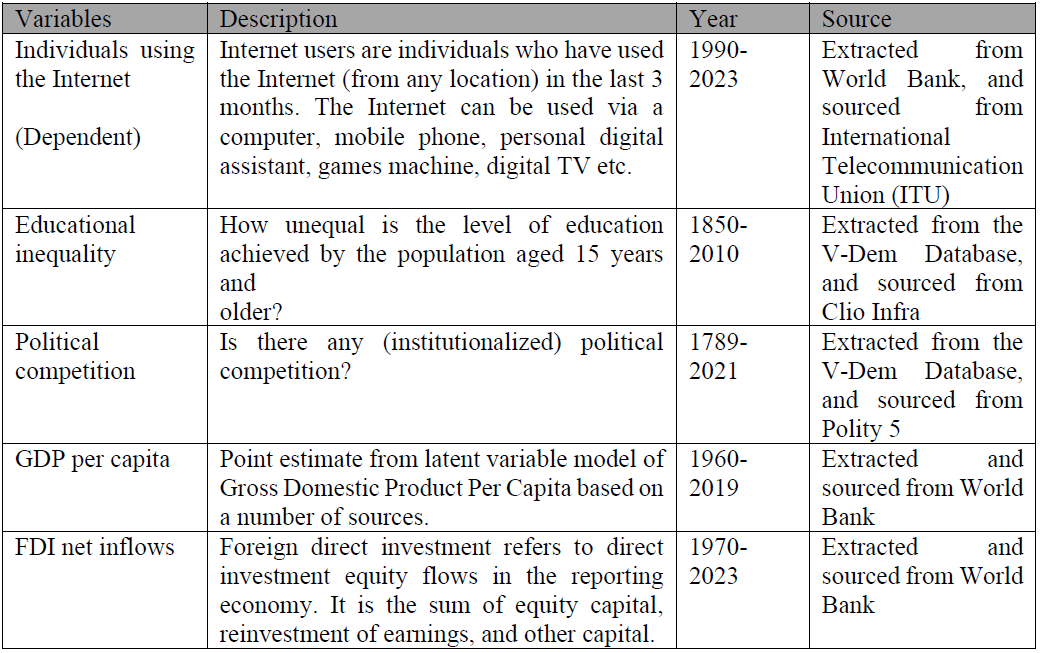
Dataset
The dataset consists of 4 variables: internet usage, GDP per capita, population, and year. The dataset is used to investigate the factors influencing internet usage growth.
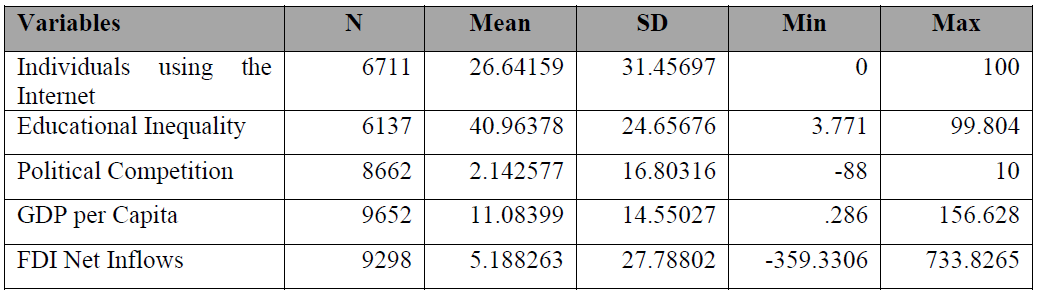
Descriptive Statistics
Descriptive Statistics
Internet Usage:
The wide range and high standard deviation reveal significant disparities in internet penetration across different regions and time periods. This variability presents an opportunity for in-depth analysis of the digital divide.
Educational Inequality:
These statistics indicate moderate average levels of educational inequality with substantial variation. This diversity in the dataset allows for robust analysis of how educational disparities might impact internet adoption.
Political Competition:
The unusual range and high standard deviation suggest the presence of outliers and extreme cases in political environments. This complexity in the data necessitates careful consideration of political factors in the analysis.
GDP per Capita:
The wide range and high standard deviation indicate significant disparities in economic prosperity across countries and time periods. This variation provides a rich dataset for exploring the relationship between economic development and internet usage.
Foreign Direct Investment (FDI):
The substantial range and high standard deviation suggest significant variation in FDI inflows across countries and years. This diversity in the data allows for a comprehensive analysis of how FDI might influence internet adoption.
Visualizing the Data
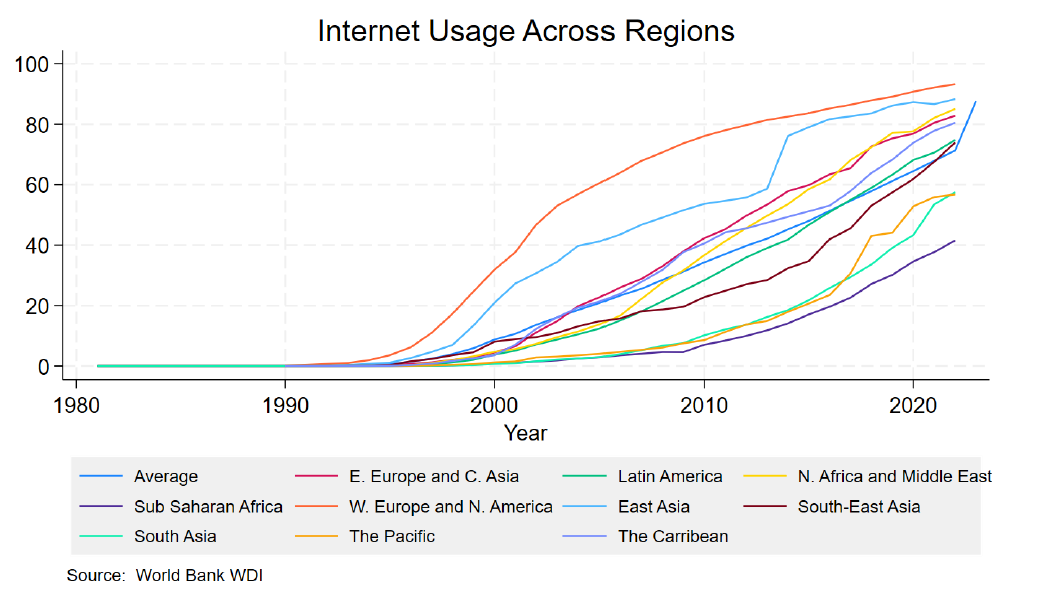
Growth of Internet Usage Across Regions
Let's start by looking at Internet Usage levels across different regions around the Globe.
Growth of Internet Usage Across Regions
While some regions like Western Europe and North America have achieved near-universal internet access, others; particularly Sub-Saharan Africa, continue to face significant gaps in connectivity. The exponential growth seen in East Asia underscores the transformative impact of strategic investments and policies aimed at digital inclusion. These trends highlight both progress and persistent disparities, emphasizing the need for targeted strategies to bridge the global digital divide.
Relationships between Internet Usage and Different Factors
Next, let's explore the relationships between internet usage and various socio-economic factors like educational inequality, political competition, GDP per capita, and foreign direct investment (FDI).
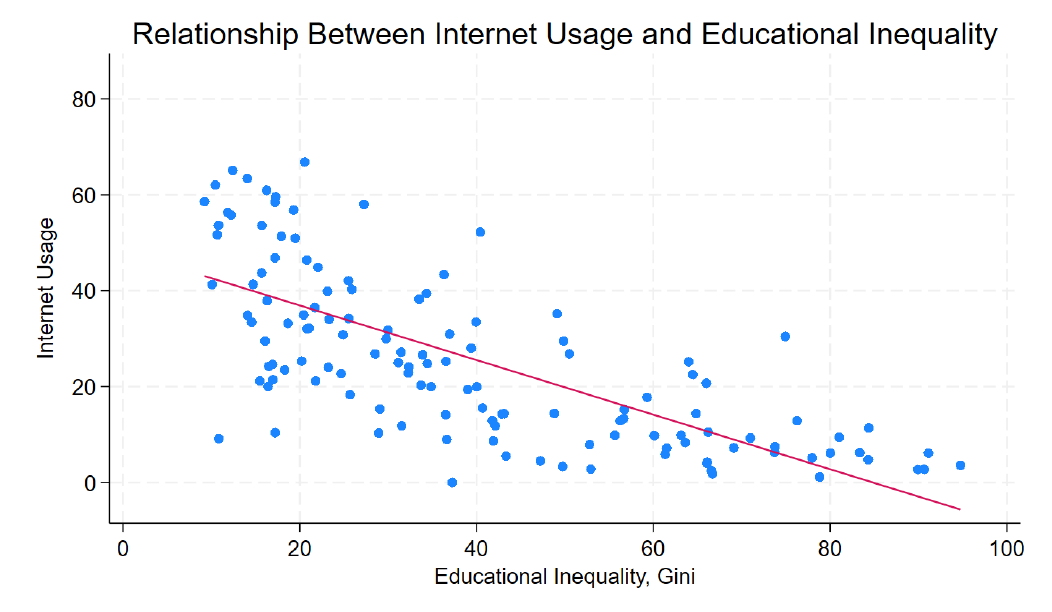
Relationship between Educational Inequality and Internet Usage
Relationship between Educational Inequality and Internet Usage
The analysis reveals a negative correlation between educational inequality (Gini coefficient) and internet usage. Countries with lower inequality exhibit higher internet adoption rates, highlighting the role of equitable education in promoting digital literacy and access. However, variability among countries with similar inequality levels suggests that factors like infrastructure, income, and policy also influence internet penetration.
Relationship between Political Competition and Internet Usage
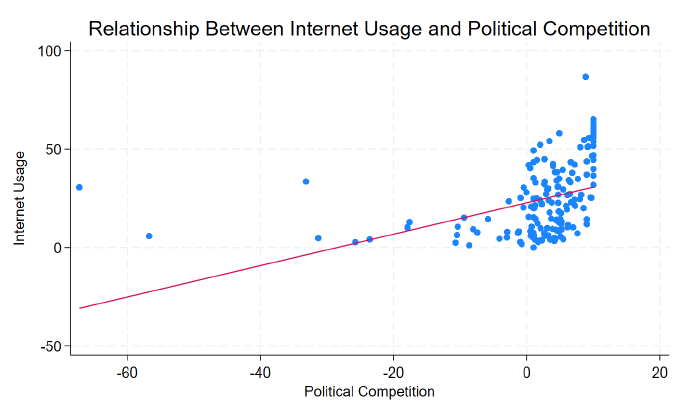
Relationship between Political Competition and Internet Usage
A positive correlation is observed between political competition and internet usage. Democratic systems with higher political competition tend to foster greater digital inclusion through infrastructure investments and inclusive policies. Conversely, authoritarian or unstable regimes often exhibit lower connectivity due to restricted access or inadequate infrastructure.
Relationship between GDP per Capita and Internet Usage
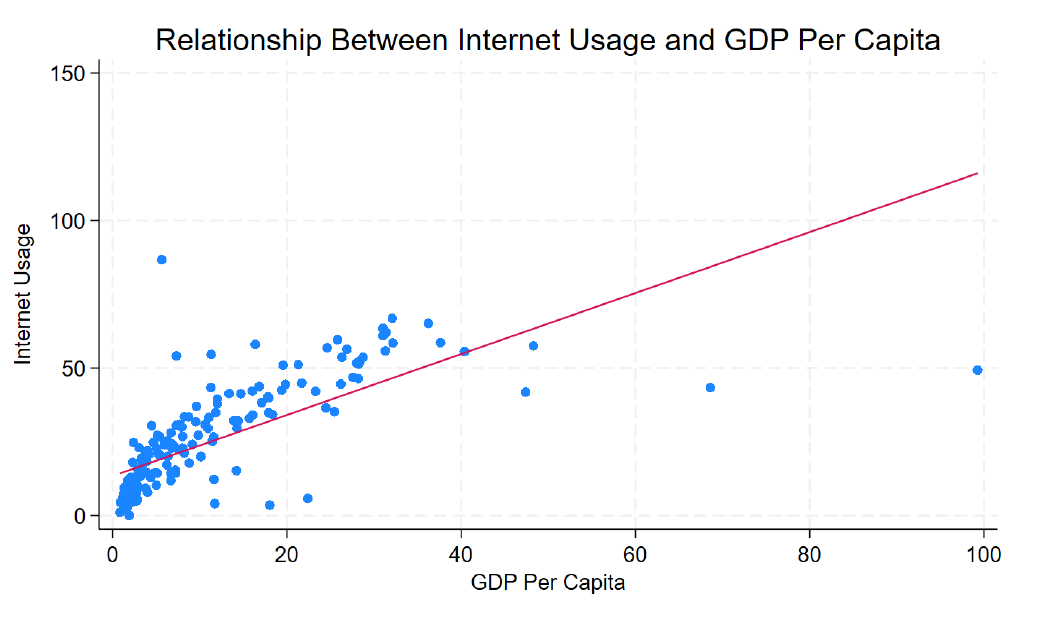
Relationship between GDP per Capita and Internet Usage
Economic development, measured by GDP per capita, strongly correlates with internet usage. Wealthier nations achieve near-universal connectivity due to affordability, accessibility, and robust infrastructure. However, disparities among countries with similar GDP levels highlight the influence of governance, infrastructure quality, and regulatory frameworks.
Relationship between Foreign Direct Investment and Internet Usage
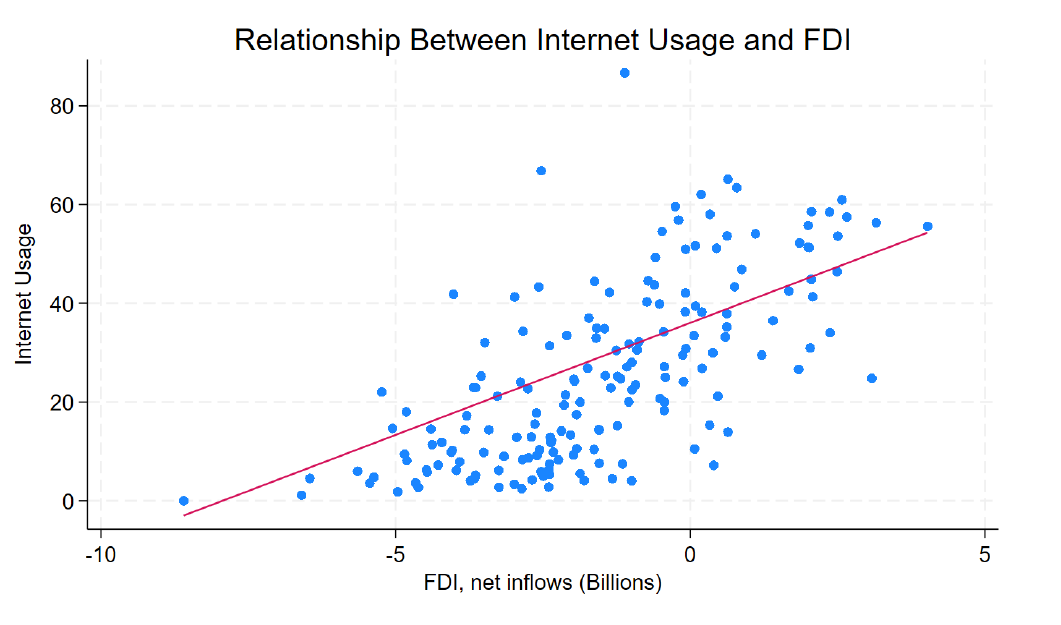
Relationship between Foreign Direct Investment and Internet Usage
Foreign direct investment (FDI) inflows positively correlate with internet adoption, emphasizing the role of external investments in funding infrastructure and technological growth. Variability at higher FDI levels indicates that the effectiveness of investments depends on governance quality and sectoral allocation.
Methodolgy
To analyze the factors influencing internet usage, I employed a fixed-effects panel regression model:

Methodology
This approach allowed me to account for unobserved heterogeneity across countries and over time, ensuring robust insights into the relationships between variables.
Statistical Analysis
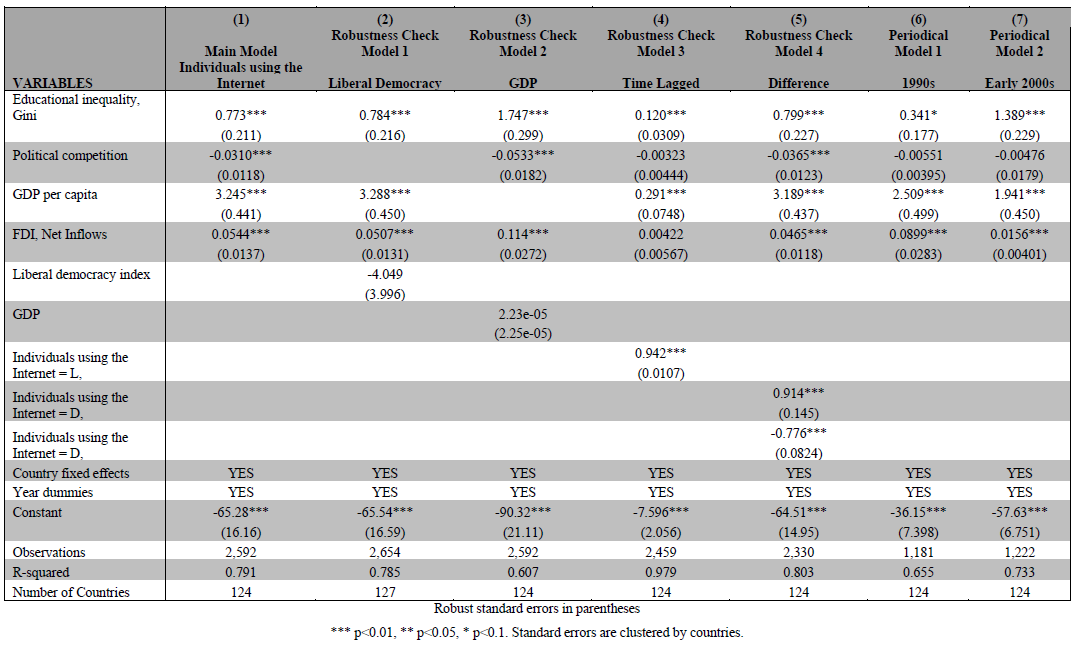
Main Model with Robustness Checks and Periodical Models
Main Model
Educational Inequality:
A 1-unit increase in the educational inequality Gini coefficient correlates with a 0.773 percentage point rise in internet usage. This suggests that in unequal societies, internet access is often concentrated among privileged groups, reinforcing digital divides.
Political Competition:
A 1-unit increase in political competition corresponds to a 0.031 percentage point decrease in internet usage. This may reflect policy instability in competitive environments or strategic internet adoption in less democratic regimes for control purposes.
GDP per Capita:
Economic development strongly correlates with internet adoption, with a $1,000 increase in GDP per capita associated with a 3.245 percentage point rise in internet usage. Wealthier nations benefit from better infrastructure, affordability, and access.
Foreign Direct Investment (FDI):
A $1 billion increase in FDI inflows correlates with a 0.054 percentage point increase in internet usage, underscoring the role of foreign investments in enhancing digital infrastructure and connectivity.
The results highlight the interplay between socioeconomic and political factors influencing global internet adoption. Policies promoting equitable education are essential to address digital divides. Political Stability may be more conducive to digital adoption than political competition. Economic development and international investments are critical for advancing digital inclusion.
Robustness Checks
To ensure the reliability of the results, I conducted robustness checks using alternative model specifications and control variables. These checks confirmed the main findings and underscored the robustness of the relationships between the variables.
Robustness Check Model 1 (Political Comptetition to Liberal Democracy)
The replacement variable, Liberal Democracy Index, is not statistically significant, unlike Political Competition in the main model. This suggests that narrower measures of political competition better capture the relationship with internet usage. Additionally, Educational inequality, GDP per capita, and FDI net inflows remain significant.
Robustness Check Model 2 (GDP Per Capita to GDP)
GDP is not statistically significant, affirming that GDP per capita is a more accurate predictor of internet usage due to its focus on individual affordability. Similar to Robustness Check model 1, Educational inequality, Political competition, and FDI net inflows remain significant.
Robustness Check Model 3 (Time-lagged Internet Usage)
The lagged dependent variable is highly significant, indicating that previous internet usage strongly influences current levels. However, Political competition and FDI net inflows lose statistical significance.
Robustness Check Model 4 (First- and second-differences of Internet Usage)
The first difference is positive and significant, demonstrating momentum in internet adoption over time. The second difference is negative and significant, reflecting a deceleration effect as adoption approaches saturation. Educational Inequality, GDP per Capita, and FDI Net Inflows remain robust predictors across this model.
The robustness checks validate the main model's findings and provide additional insights into the dynamic nature of global internet adoption. These results emphasize the importance of addressing educational inequality, fostering economic growth, encouraging foreign investments, and considering historical trends to bridge the digital divide effectively.
Periodical Models
The dataset was divided into two timeframes; 1991–2000 (Periodical Model 1) and 2001–2010 (Periodical Model 2), to analyze how the determinants of internet usage evolved during the early phases of global adoption. The results reveal significant temporal variations in the influence of key factors.
Periodical Model 1 (1991-2000)
Educational Inequality displays significance however reduced influence compared to the main model reflects that early internet access was largely restricted to affluent and educated groups, regardless of inequality levels. On the other hand, Political Competition turns out to be insignificant, suggesting political environments had minimal impact on adoption during this period. GDP Per capita and Foreign Direct Investment are both positive and statistically significant, indicating the growing importance of economic factors in driving early infrastructure development and internet adoption.
Periodical Model 2 (2001-2010)
Educational Inequality is positive and highly significant indicating its increased impact highlights the growing concentration of internet access among privileged groups, exacerbating digital divides. Political Competition remains consistent with the earlier period, indicating limited influence on adoption. GDP Per capita, while still being a key determinant, shows reduced magnitude suggesting declining costs of internet access made income less critical. Lastly, Foreign Direct Investment's lower coefficient compared to the 1990s reflects a shift toward domestic investments as infrastructure matured.
This analysis highlights the evolving dynamics of internet adoption during its formative years. The rising significance of educational inequality emphasizes the need for equitable policies to bridge digital divides. The diminishing role of FDI Net Inflows reflects a shift toward self-sustaining infrastructure investments. Economic development remains a cornerstone for digital growth, though its influence waned as affordability improved
Regional Models
Regional Models
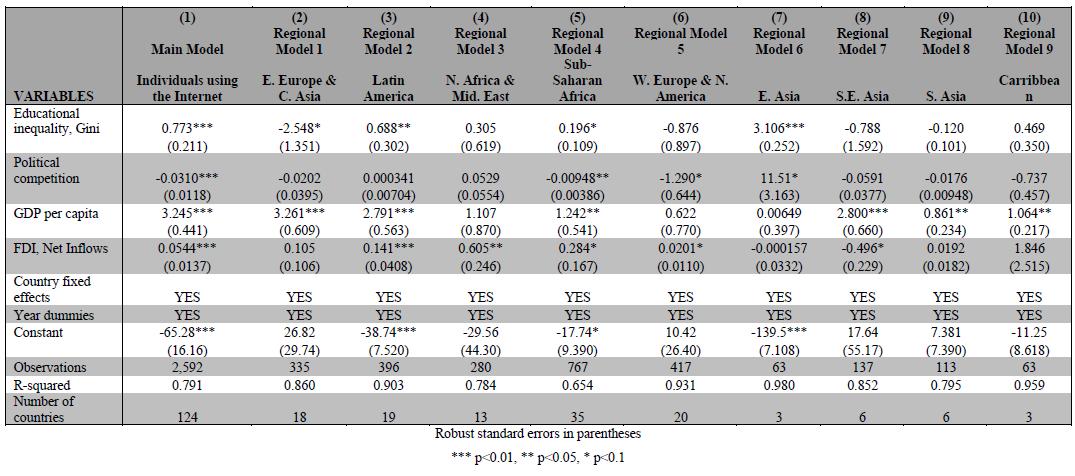
This analysis explores how the determinants of internet usage—educational inequality, political competition, GDP per capita, and foreign direct investment (FDI) vary across nine geopolitical regions. The results, summarized in the Table below, highlight significant regional differences in the factors influencing digital adoption.
Key Findings by Region
Eastern Europe & Central Asia
Educational Inequality is Negative and significant, indicating that reducing inequality promotes internet adoption. GDP per Capita is Positive and significant, emphasizing the role of economic development. FDI Net Inflows is insignificant, suggesting limited reliance on foreign investment.
Latin America
Educational Inequality is positive and significant, reflecting concentrated internet access among privileged groups. GDP per Capita is Positive and significant, underscoring economic development as a key driver. FDI Net Inflows is Positive and significant, highlighting the importance of foreign investment in infrastructure.
North Africa & The Middle East
FDI Net Inflows is Positive and significant, showing strong reliance on foreign investments for digital infrastructure. Other variables (Educational Inequality, Political Competition, GDP per Capita) are Insignificant.
Sub-Saharan Africa
Educational Inequality is Positive and significant, though with a smaller effect than in other regions. Political Competition is Negative and significant, suggesting instability in competitive political environments may hinder adoption. GDP per Capita & FDI Net Inflows are Positive and significant, with FDI playing a critical role in infrastructure development.
Western Europe & North America
Most variables are insignificant due to high internet penetration rates and equal access to resources. FDI Net Inflows is Positive but weakly significant, reflecting reduced reliance on foreign investments.
East Asia
Educational Inequality is Positive and highly significant, indicating pronounced digital divides. Political Competition is Positive and significant, suggesting that competitive political systems promote infrastructure investments.
Southeast Asia
GDP per Capita is Positive and significant, reinforcing the role of economic development. Other variables are insignificant.
South Asia
GDP per Capita is Positive and significant, though with a smaller effect due to slower economic growth. Other variables are insignificant.
Caribbean
GDP per Capita is Positive and significant, emphasizing economic prosperity as a key driver. Other variables are insignificant.
These regional models provide nuanced insights into the diverse factors shaping internet adoption across different geopolitical contexts.
GDP per Capita is the most consistent determinant across regions but varies in magnitude based on economic conditions. Educational Inequality significantly impacts regions with pronounced digital divides (e.g., Latin America, East Asia) but has minimal effects in highly connected areas like Western Europe and North America. The influence of Political Competition is context-dependent; it is positive in East Asia but negative in Western Europe and North America. FDI Net Inflows are critical for developing regions like Sub-Saharan Africa and Latin America but less impactful in developed economies with mature infrastructure.
The findings underscore the importance of tailored strategies to address regional disparities and foster inclusive digital growth.